


Regaining Courage and Curiosity

Social workers are accomplished at balancing risk management with permissiveness - that is, upholding people's right to self-determination. This tension is inherent to the job. Thresholds are there to ensure that intervention is proportionate, lawful and purposeful. In order to understand why people are in need of support, or why the actions of some people require protection for themselves or others, social workers seek to understand the complexity of people's motives, relational dynamics, and through this understanding, ensure the right help is provided.
This process is rarely deterministic, and even when significant harm has occurred, the processes of reducing the risk of it happening again is adapted to individuals. There is discussion, trial and error, and accountability for the decisions therein. Accountability means having good evidence from the person and from the law, guidance and literature that the intervention provided is appropriate and likely to be beneficial or protective.
It is unfortunate that in a profession accustomed to uncertainty and ethical dilemmas, social workers feel ill-equipped to respond to gender identity in their work. It is particularly dismaying that the constraints come from cultural and political pressure to respond to diversity in gender presentation in a prescribed, affirmative, way that loses exactly that - diversity.
Evidence for the reasons a person might express a gender identity different to their sex indicates that there is not one reason - gender distress is found in a heterogeneous cohort. The ability of social workers to practise curiosity, and furthermore without judgement nor collusion, is manifest day-to-day, and there will be many scenarios in which social workers choose to recognise that certain aspects of people's lives might be problematic, but can be left alone. There will be lots of times when this is true when working with gender identity. By the same token, social workers are used to stating the limits of what is tolerable in plain terms.
There will be times when considering someone's gender expression, the emergence of gender distress or dysphoria, or the wish to undertake social or medical transition, and the impact upon or reactions of people around that person is necessary. This is not because it pertains to gender identity or reassignment as such, but because it is social workers’ job to gather and interpret information that shapes people's choices and their impact once indicators that support or protection is needed are established.
Children's ability to make safe, insightful choices is not fully developed. In an unrelated and much more prevalent aspect of social work, namely contextual risk from grooming into criminal or sexual exploitation, it is typical to observe a child's behaviour, motive and action both recognising the child's story, whilst acknowledging that the child is at risk and unable to respond with full insight and judgement about that risk.
Testing social and physical limits, and exploring social role and identity is a vital and necessary part of adolescence. It is the role of adults to enforce limits upon these ventures, not to support an untethered pursuit, especially when it comes to immediate harm or long term consequences. This is evident in various aspects of the law including age limits on voting, marriage, smoking, alcohol, tattoos, as well as principles of Fraser and Gillick competence, that require a test of a child's capacity to make decisions without an adult. Unless a child can demonstrate specific capacity, for which a thorough interpretation of cause and consequence must be established, it is assumed that an adult with parental responsibility must make complex decisions on the child's behalf.
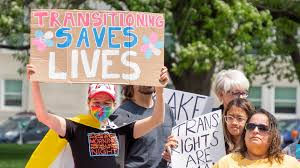
There is broad reaching recognition that being child-focussed, promoting a child's individual development and strong, positive self-worth and stable identity does not come from letting children imagine that their perspective is the only possible truth, nor necessarily in their best interest. In relation to gender identity, there is a growing body of evidence that practising affirmation closes down exploration and self discovery, and locks children into a fixed identity that brings with it complex medical and social consequences that can magnify rather than alleviate distress. Affirmation is taking place uncritically in large part because of a lack of confidence to apply curiosity in an environment where in relation to gender distress, any questions are taken to be prejudicial despite widespread encouragement in the field to be curious regarding any other social experiences associated with distress or discrimination.
Any topic that is off limits to questioning becomes a space in which aversion to naming risk can become a fertile ground for harm or exploitation. If there is fear in putting our skills into practice, all the more reason to ask - turning away is the worst thing to do. Social workers are courageous people; this topic shouldn't be exempt from the benefits of a profession whose purpose it is to face uncomfortable truths to uphold safeguarding.


Comments